Story by Lisa Pemberton | Photos & Video by Tony Overman
At least four times a day the bell tower sounds at Saint Martin’s Abbey Church in Lacey.
The alto chimes are calling the Benedictine monks, their black cassocks reaching nearly to the floor, to prayer service, including a daily Mass.
“The bells remind us that it’s time for communion with God,” explained Father Marion Nguyen, 38, a parish pastor in Bellingham before he became a monk in 2012. “Prayer is a means to the end, and that end is communion with God.”
On this day, the monks quietly file into the chapel in the shadow of the historic Old Main building at Saint Martin’s University for the noon service.
Sunshine streaming through stained glass windows throws red, amber and purple jewels of light onto the sanctuary’s floor and wooden chairs.
The monks bow their heads to the altar.
“I rise before dawn, and cry for help,” they recite, reading from the 1963 Grail translation of Psalms. “I have hoped in your word.”
The lives of the nearly 30 monks are built around a rigid schedule of prayer, worship and singing. Each has taken vows of obedience, stability (a promise to stay at the abbey) and “conversatio morum,” which loosely translates to “aid to searching for God.”
The order’s main job is to serve others, both inside and outside the monastic community. They pray for those who do not pray and for those who can’t.
“Our vocation is even more of a calling of inward holiness,” said Brother Edmund Ebbers, 66, who grew up in southwestern Idaho and has been at Saint Martin’s since 1968. “To find our Creator and to try and become one with him.”
Members of a semicontemplative community, the monks hold part-time jobs as well. Some teach or are staff members at the university.
“They are a constant reminder of who we are, what we stand for and where we came from,” said Dean Decker, a 20-year-old psychology and religious studies major at the university. “... The best pieces of advice I have ever gotten was from a man in a black robe at Saint Martin’s.”
Other monks hold jobs that support the Roman Catholic monastery and its guest house.
“We don’t just sit and read books and contemplate and think big thoughts,” said Father Peter Tynan, 46, who grew up in Nebraska and has been at the monastery for about 12 years.
Many people assume life behind the monastery’s cloister is silent, stress-free and filled with saints.
Not so, says Abbot Neal Roth, who heads the monastery and is chancellor of the university.
Monks are normal people, he notes. They bicker. They play practical jokes. They watch movies. Sometimes, they drink beer. Sometimes, they make mistakes.
“You don’t come here to escape,” said Tynan, who serves as university chaplain and the abbey’s vocations director. He also works in the special collections and archives areas of the library.
“You come because you found out this is the best place to work on your salvation.”
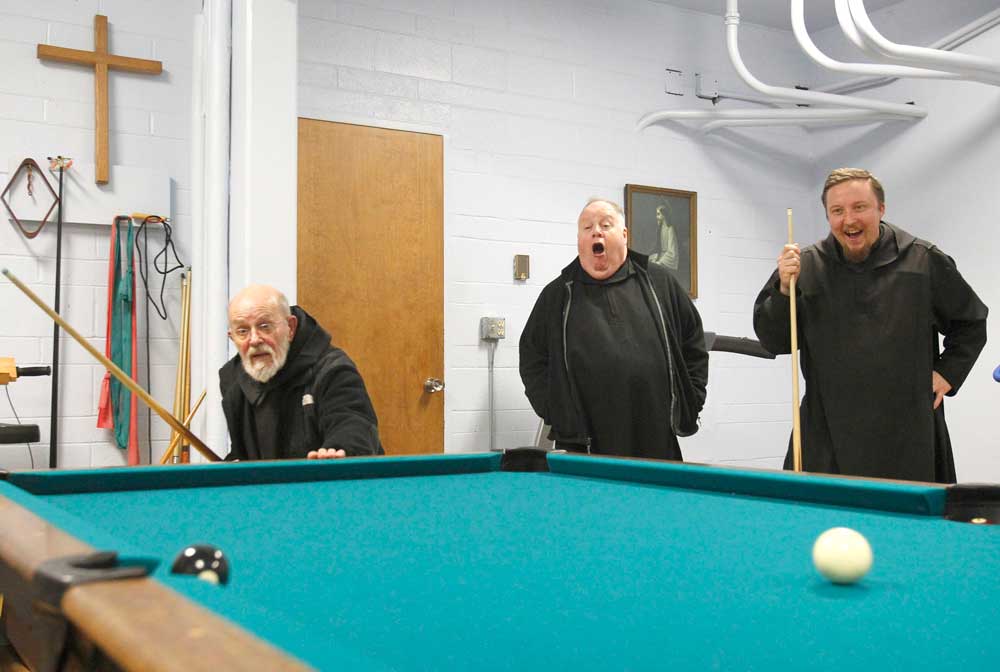
A mix of incredulity, surprise and delight fills the Saint Martin’s Abbey exercise room as a billiards shot by Father George Seidel, from left, stops on the edge of the pocket while Brothers Aelred Woodard and Nicolaus Wilson watch during a Saturday evening game in December.
MINNESOTA AND TACOMA ROOTS
In 1891, Father William Eversmann, a monk from Saint John’s Abbey in Collegeville, Minnesota, arrived in Tacoma.
He was sent at the request of German-speaking Catholics who established Holy Rosary parish in Tacoma. Within a few years, Saint John’s sent enough monks to South Sound to establish a monastery and school.
In 1894, the monks paid just under $7,000 at public auction for 571 acres in an area known as Woodland, according to “This Place Called Saint Martin’s 1895-1995,” by the late Father John C. Scott of Saint Martin’s Abbey.
About a year later, they established a private, all-boys Catholic boarding school that became Saint Martin’s University. The monks taught many of the classes and ran a farm that provided food for the school.
By 1965, the college became coeducational and in 1972, Saint Martin’s opened extension programs on Fort Lewis Army Post and McChord Air Force Base.
One of the biggest changes at Saint Martin’s came in 1980, when the first nonmonk was hired to lead the college. John Ishii, an alumnus of Saint Martin’s High School and College, served until 1984.
Ishii was charged with diversifying the college’s programs while helping it recover from longstanding debt that was “strangling” the college, according to Scott’s book.
Brother Ramon Newell, second from right, assists students last April at the Saint Martin’s University post office.
‘A RATHER STARK INTRODUCTION’
Over the years, the college, a nonprofit separate from the abbey corporation, expanded. But the monks continued to play a key role in the college.
“People always ask me what made Saint Martin’s what it was, and I always say three things: the monks, the monks, the monks,” said Tom Barte, president of the Saint Martin’s University Alumni Association. He graduated in 1968.
In the mid-1950s, Father Alfred Hulscher applied to join the monastery after attending four years at Saint Martin’s High School, and two years at its college.
“In those days, it was a rather stark introduction into being in a monastery,” said Hulscher, 81, who made his final vows to Saint Martin’s Abbey in September 1957. “... We were told we weren’t to talk to students, and not to talk to the priests.”
During his first year at the monastery, Hulscher said he wasn’t allowed to look at newspapers or have visitors, except for his parents, who were allowed to visit for an hour on one Sunday a month.
Over the years, Hulscher was trained to fill needs at the school, from high school principal to counselor. To meet his responsibilities, he earned five college degrees, including master’s degrees in library science, German and counseling psychology.
For decades, he had little say in what his job was.
“In those days, if the abbot asked you to do something, you did it,” Hulscher said.
In his decades at the school, Father Kilian Malvey, Saint Martin’s long-serving English and religious studies instructor, has held a wealth of positions — college registrar, dean of men, dean of students, director of residence, director of Campus Ministry, chairman of the English department and chairman of religious studies.
“It’s been a very blessed life in so many ways,” he said. “I love the daily rhythm of the life. I love teaching. I love working with the students and seeing them grow.”
At one time Malvey knew every student who graduated.
“I knew their first name,” he said.
Now, the college is so big, he knows only a small percentage of the students.
And because the college is only 44.5 percent Catholic, many students don’t know who the monks are, either, he said.
A few years ago, Malvey heard a student talking on the phone about the monks. He said she told her friend, “Yeah, I’m not kidding. They wear those black robes with hoods, just like in the scary movies. And they’re everywhere.”
Most of the monks have advanced college degrees and have traveled extensively for work. Most also have several jobs. Those paid for work outside of the monastery see their paychecks go straight to the abbey.
As head of the monastery and Saint Martin’s chancellor, Roth is busy with a packed calendar six days a week.
When not working, he usually spends a few hours every Monday at the abbey’s two-story cabin on Cooper Point in Olympia, where he can bake bread and find some quiet time.
“There’s still a group that teaches, and they are the spiritual portion of the school,” said Jim Guerci, director of the university’s Alumni Relations program. “They are the spiritual backbone of the school. It’s still a Benedictine school.”
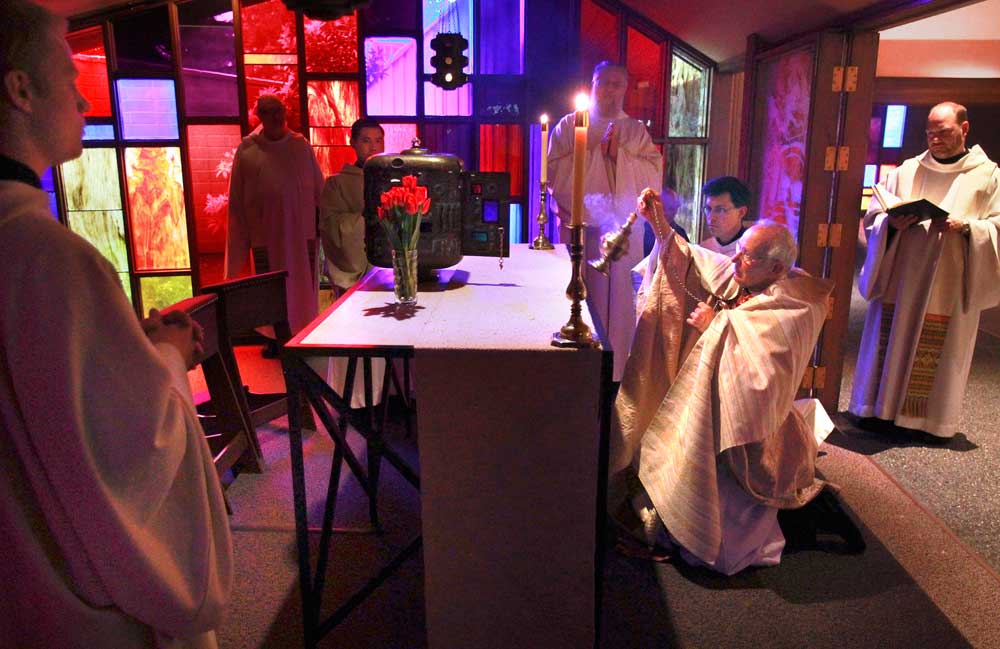
Saint Martin's student Ben Lopez, from left, guest priest Father Jack Frerker, Brother Martin Dinh, Brother Edmund Ebbers, Brother Mark Bonneville, Abbot Neal Roth and Father Peter Tynan wrap up the Holy Thursday service in the Blessed Sacrament Chapel at Saint Martin’s Abbey Church last April.
A DAY IN THE LIFE
Benedictine monasteries around the world are known for their hospitality and architecture.
For years, Saint Martin’s monks resided in the university’s first building, built in 1895. They also lived in Old Main, a brick Collegiate Gothic Revival style building that opened in autumn 1913.
Today, the monks live in a modest four-story building that was dedicated in 1957. The beige and tan building features a community room, some TV rooms, a small library and an exercise room.
Other than Roth, who has a small apartment, the monks sleep in small rooms.
“Basically a monastic cell is a dorm room,” Tynan said.
Malvey, 78, wakes up at 4 a.m. to make coffee and read a little. He showers and shaves before the monks gather for their 6:30 a.m. prayer service.
After that, they eat breakfast in their dining hall, and then it’s off to their other work.
“I usually teach an 8 a.m. class,” said Malvey, who has taught English and religious studies at Saint Martin’s University for 54 years.
As director of the school’s Benedictine Institute, he often has meetings in the morning before returning to the abbey for the noontime prayer service and communal lunch.
The monks eat their simple meal — usually soup, salad and sandwiches, or a light entree — in silence, listening to a reading. Afterward, they return to their jobs.
Malvey often teaches a 1 p.m. class, and, because he’s on several university committees, gears up for more meetings. He likes to get back to his room by 4 p.m. to relax a little before the 5 p.m. Mass.
Dinner is at 6 p.m. in the dining hall. At 6:30 p.m., a bell signals it’s time to meet in the recreation room for community time.
“We pray really slow, and we eat really fast,” Father Nguyen said with a laugh.
The monks spend the hour socializing, relaxing and bringing their community together. As Saint Martin’s University students have rumored for years, there’s beer on tap. Wine and soft drinks, too.
“Usually we play cribbage and talk to each other,” Nguyen said.
Another popular activity is the board game Ticket to Ride.
“Guys started going on Google to find strategies on how to play it,” Nguyen said.
The monks gather for their final corporate prayer at 7:30 p.m. Some choose to pray together at other times, but it’s the last service of the day they’re required to attend.
Malvey said he usually stays in the monastery after 8 p.m. “unless there’s a Saints basketball game.”
He might watch a movie on DVD, or read a book or a newspaper. He usually eats a piece of toast or some cereal before going to bed at 11:30 p.m.
Father Clement Pangratz, from left, Father Alfred Hulscher, Abbot Neal Roth and Father George Seidel eat lunch silently while listening to a reading April 9. The monastic dining room is located on the first floor of the Old Main building on the Saint Martin’s University campus.
DOWN IN NUMBERS
The monastery’s ranks once swelled to nearly 100 men.
Today, the abbey’s membership has dwindled to 27 monks, including seven monks who live outside of the monastery because of their studies, parish assignments or nursing care needs.
A monk doesn’t have to be an ordained priest. Those who are go by the title “father.” Those who aren’t are referred to as “brother.”
The average monk is in his 60s; the oldest is 92. Six “young guys” are under 40.
“We’re becoming a rather elderly community these days,” Malvey said.
There have been big turnovers in consecrated life in the past.
Between 1974 and 1978, the abbey lost 34 of its 96 monks, and “only 11 are in the cemetery,” former Abbot Adrian Parcher wrote in a front-page story of The Olympian on Easter Sunday 1985, according to Scott’s book.
Roth believes Vatican II, a time when the Catholic Church overhauled its rules, contributed to the sharp decline.
Hulscher believes it was because of leadership at the abbey.
“My impression is there were people who were there, some of them probably shouldn’t have been there in the first place,” he said. “We had an abbot who was basically opening the door to anyone and everyone who was coming down the pike.”
Today, monasteries seem more selective with their candidates, said Owen Cummings, the academic dean and professor of theology at Mount Angel Seminary near Salem, Oregon.
There’s “perhaps a more mature approach to religious life, requiring people to genuinely reflect on what they were entering rather than just going along for the ride, if you will,” he said.
Roth agrees. Like many men in his generation, he entered the monastery as a young man — in his case in 1957 at age 18.
“Families thought that was wonderful — that they were truly blessed,” Roth said. “It was always encouraged.”
Many young people today aren’t ready to settle down or commit as early as in past generations, he said, plus, today’s monasteries are looking for men with some life experience.
An 18-year-old who showed interest in joining Saint Martin’s would be welcome to visit, but not allowed to join right away, the abbot said.
“I would tell him, ‘Listen, I want you to go to school for a year or two, get a job, date, volunteer with an organization and come back and visit us,’” Roth said.
In the same regard, Saint Martin’s rarely admits postulants older than 40. Roth recently received an inquiry from a man in his 70s who wanted to join the monastery.
“If they’re 40 or older, they just have too hard of a time adapting,” Roth said. “We are very particular. We have to be. We’re not here to fix people’s lives or take care of people.”
Father Peter Tynan, from left, Father Bede Classick and Father Marion Nguyen enter the Saint Martin’s Abbey church chapel, which is filled with worshippers, for the popular Easter candlelight service Saturday night, April 19, 2014. Both Tynan and Nguyen said they knew as very young children that they were called to the priesthood.
‘#COFFEE #JESUS #MONKLIFE’
Saint Martin’s and other monasteries are working to build a future by reaching out to prospective recruits in a modern way — via the Internet.
In the past year, the monks began making a recruiting video to highlight their lives. They also are working on a website with information for potential recruits, those they refer to as vocations or those called to serve God.
Several monks regularly use Twitter, Facebook, Instagram and other social media to interact with the public.
“We need to be out there and have a social media presence,” Tynan said.
The abbey established its Facebook page in 2011, and the monks regularly use it to post photographs of their activities, as well as for distributing devotional information and the abbey’s Mass schedule.
Nguyen posts on Twitter. His handle is @MarionTheMonk, and he routinely tweets a mix of selfies and Scriptures.
On a recent day he tweeted a photo of himself holding a mug of coffee with the message, “Best way to begin the day! #coffee #Jesus #monklife.”
Some monasteries operate informational websites that are getting traffic, even overseas, Cummings said.
“I hear from a colleague in Oregon that his website is getting hits from the Philippines and parts of Africa,” he said. “So people are looking.”
In addition to connecting with people online, monasteries, including Saint Martin’s, are inviting men to try the life firsthand — similar to a college weekend visit.
“Those are very helpful because what you see is what you’re going to get,” Cummings said.
In 2012, the university began the Benedictine Institute Scholars Program, as a way to continue its faith-based heritage and mission.
Students don’t have to be Catholic to participate, though they must embody the Benedictines’ core values of faith, reason, service and community.
The Benedictine Scholars participate in service projects and retreats with Saint Martin’s monks and live on a floor in a residence hall designed for those in student leadership. They can earn an annually renewable $10,000 scholarship.
Decker, who considers himself a pluralist or a self-described Buddhist/Hindu/Christian, is one of 10 in the interfaith program’s inaugural class.
“It has become our mission to uphold the Benedictine values so essentially it feels as if the monks are plentiful,” he said.
“We are not necessarily asked to become monastic ourselves, but to live the values in similar ways that the monks do that are more applicable to our lives in such a way the school will never cease to be influenced by what started it in the first place.”
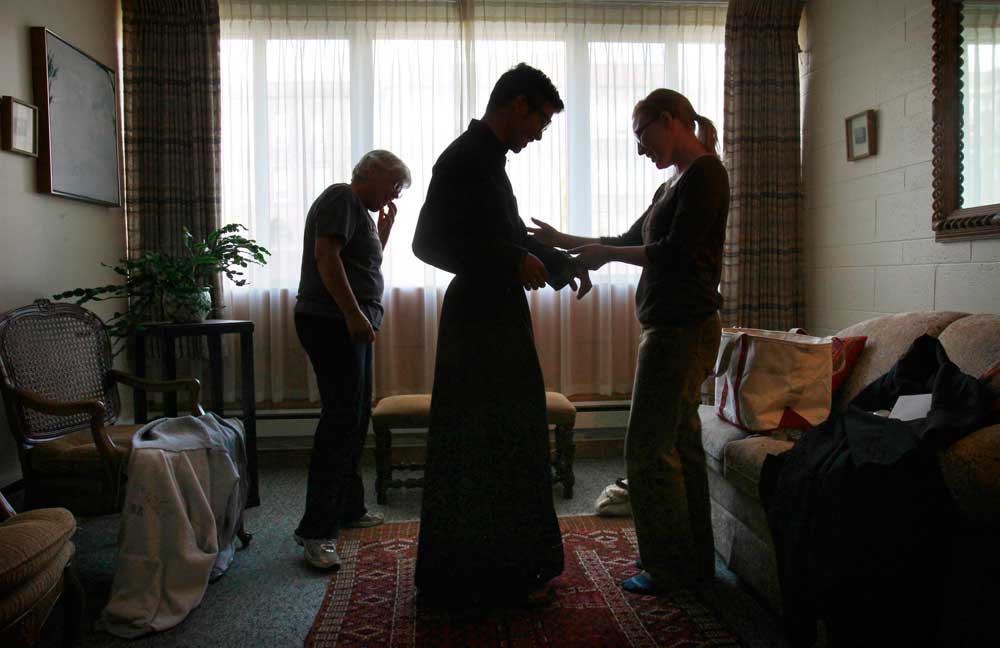
Gus Labayen gets fitted for a monk’s robe by seamstress Heather Lirette of Lacey, only the fifth seamstress in the history of Saint Martin’s Abbey. Assisting at left is apprentice seamstress Johanna Mitchell of Lacey. After several months trying out the abbey life as a postulant, Labayen decided not to join the monastery.
JOINING THE ORDER
About eight years ago, Mark Bonneville, 32, was a package handler for United Parcel Service in southwestern Washington.
The Nebraska native converted to Catholicism at 14 and, thanks to his volunteer work with the Knights of Columbus, knew he wanted to do some type of service work.
One night, while roaming the Internet, he came across a religious placement service website. On a whim, Bonneville submitted his information, not because he wanted to become a monk, but because he was curious about what they do.
He visited Saint Martin’s and found a community he said took to heart its promise to be hospitable, a rule of Saint Benedict.
“That was ... ‘Wow,’” Bonneville said. “All of the monks were very welcoming, very interesting.”
Six months later, after several more visits to Saint Martin’s, Bonneville applied to join the order.
How was that received by his friends and family?
“They didn’t tell me this, but it was like, ‘You’re crazy — you have your whole life ahead of you,’” Bonneville said.
The first stage of becoming a monk is known as postulancy, from the Latin word for “asking.” The tryout period usually lasts several months, and allows the men to get to know each other.
The second stage, novitiate, is more formal and includes instruction on vows, the history of monasticism and church doctrine. It usually lasts about a year.
Next, monks take temporary vows of poverty, chastity and obedience, in a stage that lasts about three years.
“During that time, you continue to discern whether this is for you or not,” Roth said. “Not everybody makes solemn vows. Some leave.”
When a Benedictine monk takes those final vows — Bonneville took his on July 11, 2012 — he promises to follow the rule of stability, which means he’ll stay until his death.
In turn, the abbey will take care of all of his needs, from housing and clothing to medical bills and meals.
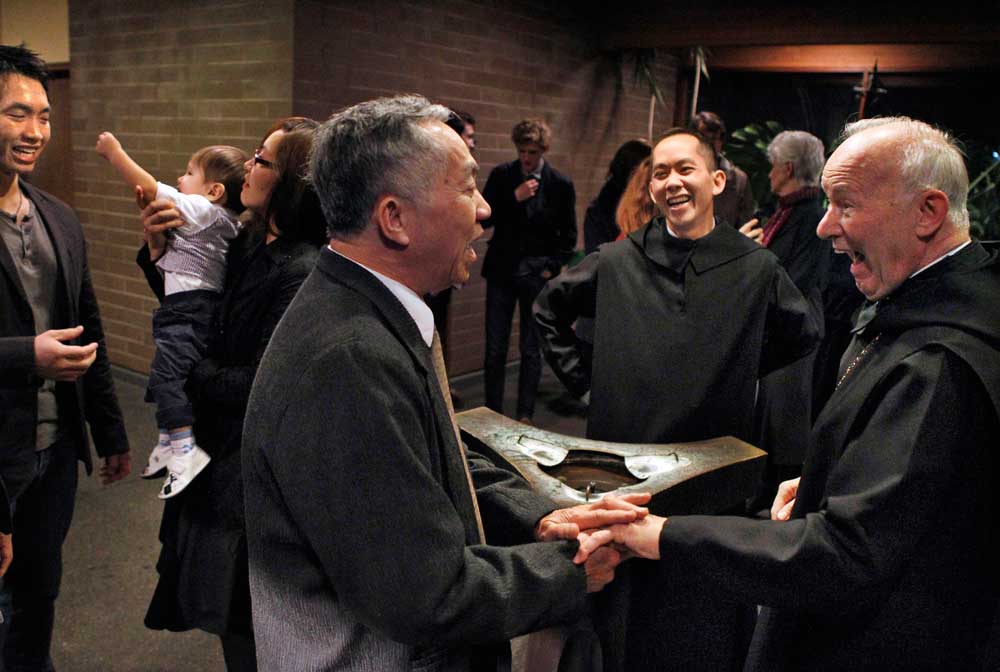
Abbot Neal Roth, right, greets Thien Nguyen, the father of Father Marion Nguyen, center, after church services on Thanksgiving Day. From left to right are Marion Nguyen’s brother-in-law, nephew and sister. Nguyen posts on Twitter. His handle is @MarionTheMonk, and he routinely tweets a mix of selfies and scriptures.
‘A CERTAIN MYSTIQUE’
Gus Labayen, 26, considered joining Saint Martin’s as a postulate last year.
Eventually he decided not to pursue it.
Labayen had considered the calling since high school, when a Saint Martin’s monk presided over Mass at his hometown church, Saint Nicholas Catholic Church in Gig Harbor.
“I think there’s a certain mystique when you’re from the outside,” he said.
Labayen visited the monastery several times during breaks from Central Washington University, where he studied music.
“I would come and visit and get to know the monastery and the community,” he said. “Over time, it was just a relationship that blossomed.”
Labayen moved into the monastery over Martin Luther King Jr. weekend in 2014. He wore a hand-me-down habit from a monk who had died, participated in daily services and studied organ music with one of the priests.
He performed manual labor, including cleaning cars, chopping wood and working on grounds maintenance. Among his chores was cleaning the monastery’s bathrooms, a tradition for postulants at Saint Martin’s.
“Yes, I was scrubbing toilets,” Labayen said. “I wouldn’t say it was a highlight.”
He was able to “unplug” from the outside world and enter a sheltered community. He was required to give up his cellphone. Instead, he listened to stories from older monks and played a lot of cribbage.
“There’s a stereotype that monks don’t talk much and are withdrawn, and I found that really to not be the case,” Labayen said.
He said he learned about how hard the monks work, how dedicated they are to their calling and their community.
“Although the community is a lot smaller in numbers (than previous years), I think the quality of the men there is astounding,” Labayen said. “All of them were role models to me, and I learned something every day from each and every one of them.”
The biggest lesson, he said, was the most painful: He wasn’t ready to become a monk, now or possibly ever. It wasn’t in his heart to make that commitment.
“I changed my mind,” Labayen said. “I think, after some prayer and discernment, that this is a time to switch gears and try something else.”
Labayen said it wasn’t an easy decision to make.
“We never know what the future holds, but I felt it was for the best,” he said. “It was a little bittersweet, but certainly not like the end of my relationship with them.”
Labayen said he’s grateful for his time at Saint Martin’s, but noted it had its challenges. It’s not easy to join a community, he said, especially when you’re fresh out of college and the median age of your housemates is your grandfather’s.
“I found it’s very humbling to be part of that process and admiring for other people who take that step and try out the religious life,” Labayen said.
He added, “It was a very spiritual and personal growing time for me. And I’m glad the community at Saint Martin’s had the encouragement and the time to invest in my future.”
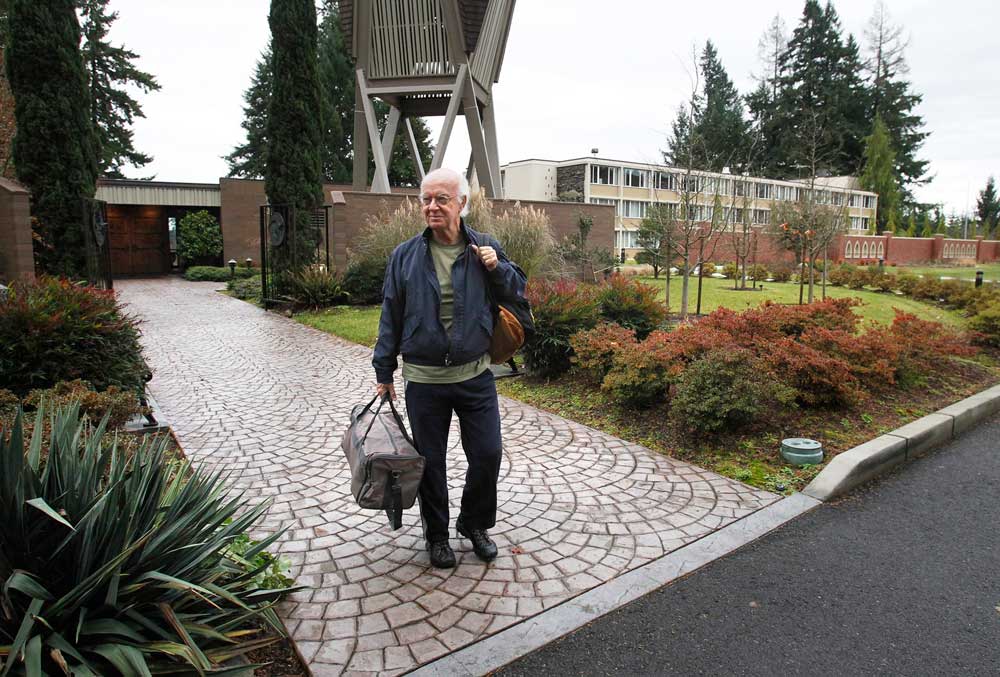
Father Kilian Malvey waits outside the Saint Martin’s Abbey for a ride with a student to visit family in Port Angeles over the Thanksgiving holiday.
THE MODERN MONK
Roth was 18 when he arrived at the abbey on June 30, 1957. One of his cousins was a novice at the monastery.
“I was impressed with the fact that they prayed together, every day, several times a day,” Roth said.
He majored in education and English at what then was Saint Martin’s College, and received a master’s in theology at Mount Angel Seminary.
Sometimes he’s asked to visit classes to give insight on monastic life. Students often ask about the monks’ black habits, which they usually wear only on campus. Many want to know what Roth wears under his black habit.
“I always lift up this part,” he said, folding up the edge to his knee, “and say, ‘Well, trousers, like anyone else.’”
Nowadays, he added, some of the younger monks prefer to wear shorts.
Another popular question: What do monks do for fun?
“I tell the students the younger monks might go out to a movie and have pizza and beer,” Roth said. Of course that happens only with the abbot’s permission and using money he has given them, other monks said.
The main part of a monk’s work — gathering for prayers and a daily Mass — hasn’t changed much in the past half century, Roth notes.
Still, there are greater opportunities for a monk to expand his education, and the lifestyle isn’t as strict as it used to be, he said.
“In some ways, we’re more modern,” Roth said. “Monks can go out to a movie. When I entered, there was none of that.”
For those of the order, life continues to be a balance of old and new, individual journeys of deep faith mixed with support from a community of brothers; prayer and work; a world kept private behind a cloister that is trying to save itself with the Internet and social media.
Roy Heynderickx, who has served as the university’s president since 2009, said the monks remain an essential part of the Saint Martin’s experience.
“Their presence, in and outside of the classroom, is a constant reminder of the spiritual side of life — a concept that many young people do not have the opportunity to reflect upon until they come to Saint Martin’s,” he said.
But the monks’ lives remain dictated by rules Saint Benedict wrote more than 15 centuries ago. And even if the size of the abbey continues to shrink, none of the monks believes it will disappear.
“We have a history, a tradition, a culture,” said Brother Ramon Newell, 69. “It’s not something that’s going to blow away like a breeze.”